


The Role of Trees in Environmental Protection and the Necessity of a Sustainable Global Environment
Published:
৬ জুন ২০২৬, ১০:৩৮
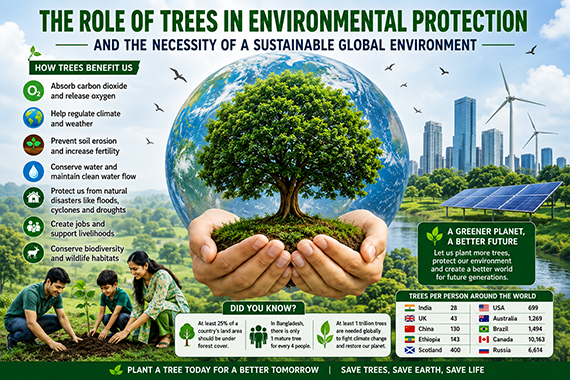
Among the wondrous beauty of creation, trees stand as one of the most essential elements; without them, life for all living beings would be impossible. Since the beginning of creation, humans and other প্রাণিকুল have depended directly and indirectly on trees. Trees are the greatest friends of nature, the environment, and all living organisms. Alongside maintaining ecological balance, they play a vital role in sustaining human life and livelihoods. Forests are part of our national heritage. Their importance in maintaining balance in the national economy, weather, climate, and natural environment is immeasurable.
Trees play an undeniable role in preventing floods, tidal surges, droughts, cyclones, excessive rainfall, and other natural disasters. From birth to death, human life is deeply connected to trees. It is impossible to imagine life on Earth without them.
Trees: Our Greatest Friends
Trees contribute immensely to human welfare by providing food, medicine, clothing, housing materials, preventing soil erosion, regulating climate and weather, ensuring clean water flow, increasing agricultural productivity, creating employment, and reducing unemployment. Without trees, forests and wildlife would not exist. Trees are a priceless gift from Almighty Allah. Therefore, deforestation is a curse for any country or nation.
There is an intrinsic relationship between trees and the environment. Trees are our closest allies, yet we often fail to treat them with care. Forests are destroyed without reason or for trivial purposes. Trees are a crucial component in maintaining ecological balance in any country.
Trees Are Essential for Ecological Balance
Trees do not only absorb carbon dioxide and release oxygen. Large trees also help prevent lightning strikes. Environmental degradation has led to increased deaths from lightning in recent years. The frequency of natural disasters such as droughts, excessive rainfall, landslides, and cyclones is increasing day by day.
Uncontrolled deforestation must be stopped. Without forests, the environment would become unbearably hot, turning the Earth into a desert and threatening human existence. There is no alternative to afforestation in protecting nature and the environment. Despite modern urban development, human survival without forests is impossible.
The Importance of Social Afforestation
Although millions of species exist on Earth, deforestation is destroying biodiversity. Humans are primarily responsible for disrupting ecological balance. Many selfish individuals continue to clear forests. Due to population growth, land is increasingly needed for housing, agriculture, and industry, leading to further deforestation.
As a result, wildlife loses food and habitat, biodiversity declines, and ecological balance is disrupted. Natural disasters increase, causing damage to crops and human life. To overcome this crisis, social afforestation is essential.
At Least 25% Forest Coverage Is Necessary
Forests not only enhance natural beauty but also play a crucial role in maintaining environmental balance. They help purify and cool the atmosphere. Areas with more trees receive better rainfall, increasing water availability and agricultural productivity. Trees also improve soil fertility and prevent erosion. They help protect against storms, floods, and heavy rainfall.
To build a livable world for future generations, planting trees—not cutting them—must be our goal. Ideally, at least 25% of a country’s land area should be covered by forests.
Forest Resources in Bangladesh
According to government statistics, forest coverage in Bangladesh is around 18%. Major forest regions include the Sundarbans in the southern coastal area, forests in Chattogram, the Chittagong Hill Tracts, Sylhet, as well as areas in Mymensingh, Gazipur, Tangail, Rangpur, and Dinajpur.
However, excluding the Sundarbans, the remaining forest area is very limited. According to the World Resources Institute, it is only about 5%. Bangladesh is a densely populated and relatively small country. A 2010 labor survey showed that out of 57.1 million civilian workers, a significant portion is engaged in forest-related or forest-dependent production activities.
Previously, 28 out of 64 districts had no afforestation programs. Now, social afforestation activities are being conducted in almost all districts.
Let Tree Plantation Become a Social Movement
Tree plantation is essential for maintaining ecological balance, creating a pollution-free environment, achieving economic development, and reducing poverty. Bangladesh has immense potential for afforestation, which must be properly utilized.
A well-planned garden can become a source of income for future generations. To build a livable country, tree plantation must become a social movement.
Global Tree Statistics and Urgency
In India, there are approximately 28 trees per person. In the United Kingdom, there are 43 trees per person; China has 130; Ethiopia 143; Scotland 400; the United States 699; Australia 1,269; Brazil 1,494; Canada 10,163; and Russia 6,614 trees per person.
In Bangladesh, there is only one mature tree for every four people. Each of us should plant at least one tree. Currently, the world needs approximately one trillion trees. If one trillion trees are planted globally, they could absorb around 200 gigatons of carbon and help restore the climate to conditions similar to those of 100 years ago.
Author: Special Correspondent, Daily Voice of Asia

Comment: